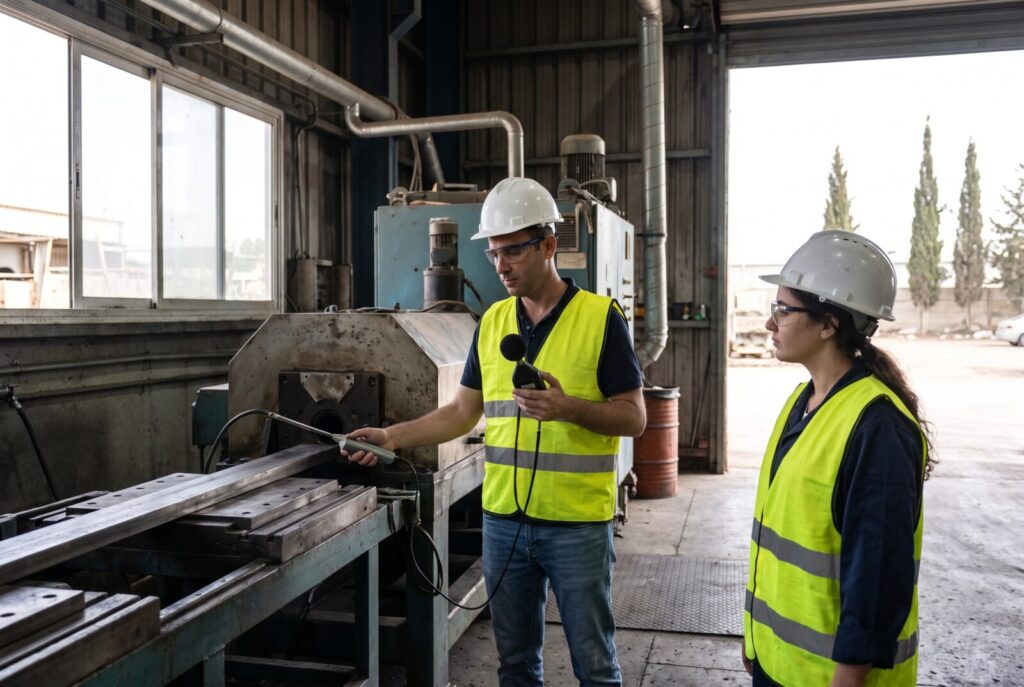

After dozens of safety audits in organizations across various sectors, a clear pattern emerges: most deficiencies are neither unique nor surprising. The same five mistakes recur almost everywhere, regardless of the organization's size or industry.
What they all share is that they do not stem from negligence. They stem from systems that were built correctly at a certain point in time and have not been updated since, or from procedures that exist on paper but not on the floor.
This article details the five mistakes, why they arise, and the practical way to close them.
Why the Same Mistakes Keep Recurring
A safety system is a living system. Production processes change, equipment is replaced, employees come and go, and subcontractors enter and leave. Safety documents, by contrast, tend to stay in place.
This gap between documented reality and actual reality is the source of nearly every deficiency found in an audit. That is why the solution is almost never writing a new procedure, but building a mechanism that ensures existing procedures stay in sync with the field.
The Five Mistakes
1. A Risk Assessment That Is Never Updated
The risk assessment is the foundation on which the entire safety system rests. In practice, in many organizations it is written once and filed away in a binder. Every change to the production line, every new machine, and every change to the warehouse layout alters the risk map, and without an update, the assessment describes a plant that no longer exists.
The solution is not a new assessment every year, but defining events that mandate an update: equipment installation, a process change, a safety incident, or a contractor starting a new activity.
2. Training That Is Documented but Not Embedded
A signed form is not proof of understanding. Audits repeatedly find employees who have signed off on training on a topic they cannot actually describe. The reason usually lies in generic training that is not tailored to the specific workstation, or in training delivered in a language that is not the employee's native language.
Effective training is short, focused on the workstation, delivered in a language the employee understands, and accompanied by a brief comprehension check, not by a signature alone.
3. Partial Contractor Management
Subcontractors are the most common weak point. They are on site temporarily, not always known to the permanent staff, and sometimes perform the most hazardous work: work at height, hot work, or work in a confined space.
Proper management requires a clear chain: prior approval of the contractor, safety coordination before work begins, a work permit for special activities, and actual supervision, not just at the start of the day.
4. Protective Equipment That Exists but Is Unusable
Emergency showers that cannot be reached, fire extinguishers past their expiration date, emergency exits blocked by goods, and railings removed for maintenance and never replaced. These are deficiencies that require not a budget but a routine of inspection.
A short weekly safety round with a checklist of just ten items closes most deficiencies of this kind before they become an incident.
5. An Incident Investigation That Stops at the First Question
When an investigation concludes that the employee did not follow the procedure, the investigation is not complete. The next question is why the procedure did not fit reality, and why it was easier to bypass it than to follow it.
A good investigation reaches the systemic root cause and produces a conclusion that can be implemented at the process or equipment level, not only at the behavioral level.
How to Close the Gaps
Three simple mechanisms close most of the gap between paper and field: defined events that require updating the risk assessment, a short periodic safety round with a fixed checklist, and an orderly coordination process for every external party entering the site.
None of the three requires a complex system. They require clear ownership of the process and a schedule that someone is responsible for.
Summary
A good safety audit does not produce a list of deficiencies but a map of missing mechanisms. The five mistakes described here recur because they concern the ongoing maintenance of the system rather than its construction, which is exactly the part that is easy to postpone. An organization that treats safety as a continuous process rather than a one-time project finds that most deficiencies disappear on their own.